
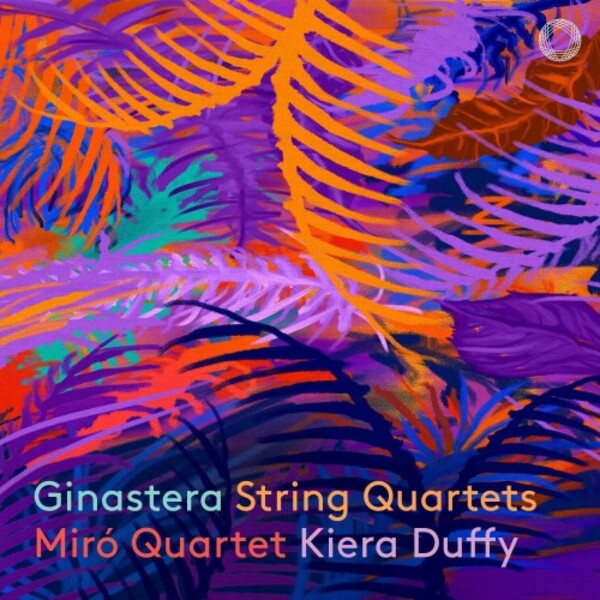
C’est une expérience assurément très forte d’aborder l’œuvre tout à fait impressionnante du formidable Alberto Ginastera (Buenos-Aires, 11 avril 1916 – Genève, 25 juin 1983), immense compositeur du XXe siècle, par ses trois splendides et singuliers quatuors à cordes Op. 20 (1948), Op. 26 (1958-1968) et Op. 40 (1973-1978), dans l’interprétation au disque du Miró Quartet – constitué de Daniel Ching et William Fedkenheuer, violons, John Larges, alto, et Joshua Gindele, violoncelle – et Kiera Duffy, soprano, en le splendide CD Pentatone PTC 5187 412 « Ginastera – String Quartets » – enregistré à Austin du 2 au 7 décembre 2024…
…
Et regarder ici cette brève vidéo (de 0′ 54) d’un trop court extrait du stupéfiant Quatuor n°3 Op. 40, avec la participation de Kiera Duffy, soprano…
…
…
Sur ce tout à fait marquant CD,
lire l’article « Ginastera – String Quartets- album review – compelling and colourful » du Guardian du 24 juillet 2025 sous la plume d’Andrew Clements, qui va en peu de mots à l’essentiel :
…
…
Lire aussi la précise recension de ce CD par Andrew Farach-Colton parue dans Grammophon au mois de septembre 2025 :
…
Andrew Farach-Colton
Each of these three quartets comes from a distinct stylistic phase – c’est important – in Alberto Ginastera’s output. The First (1948), from the end of the Argentine composer’s self-described period of ‘Objective Nationalism’, abounds with rhythmic energy, swinging syncopations and blunt, folk-like melodies. Initially, I thought the Miró Quartet’s tempo for the opening Allegro violento ed agitato a bit slow, but checking the score it seems they’ve hit the suggested metronome mark spot on. Not only that, but the scherzo-like Vivacissimo that follows has exactly the same marking (with more notes per beat, so it seems faster), linking the movements in an illuminating way.
The language of the Second Quartet (1958), from the period of ‘Subjective Nationalism’, is considerably more dissonant – voilà – and its emotions far more febrile – listen, say, to the fever dream at 2’30 » in the Adagio angoscioso – but this work often retains its predecessor’s syncopated drive, too, as if Ginastera had taken many of the sounds and techniques developed by Schoenberg et al – voilà – and made them his own. And even in the modernist, or ‘neo-expressionist’, world of the Third (1973), the terrain of the Argentine pampas is still faintly recognisable. This final entry in the genre employs a soprano (modelled after Schoenberg’s Second Quartet – en effet – ) who sings settings of poetry by Jiménez, Lorca and Alberti in four of the five movements.
Benita Valente sang the premiere of the Third with the Juilliard Quartet in 1974 but didn’t record it until 2000 (Bridge) – again with the Juilliard – when her voice had lost some freshness. It’s a terrific performance nonetheless, but this new one is even better. Kiera Duffy negotiates the Drammatico movement’s high-wire vocal act with aplomb and is warmly expressive, even romantic, in the yearning Amoroso at the quartet’s centre and in the other-worldly finale.
There have been satisfying recordings of the three Ginastera quartets by the Latinoamericano (Brilliant), Lyric (ASV, 10/96) and Enso¯ (Naxos) quartets, but the Miró give the most technically polished accounts yet – voilà – of these extraordinary works – assurément ! Il faut vraiment les découvrir !!! – , and the foursome’s scrupulousness in no way inhibits the sheer gusto with which they dig into them. All in all, then, a stunning achievement – and gorgeously recorded, too – parfaitement…
…
Et surtout regarder la vidéo enthousiaste (de 6′ 05) de Dave Hurvitz, en date du 24 août 2025…
…
Cf aussi mon précédent article « Revenir explorer avec intense plaisir l’oeuvre d’Alberto Ginastera (1916 – 1983) : le beau CD cpo « Alberto Ginastera – String Quartet N°1 – Piano Quintet Op. 29 – Maurice Ravel – String Quartet Op. 35 » du Minguet Quartett et Michael Korstick… » en date du 16 avril 2026, qu’on peut relire ici…
…
…
Ces trois Quatuors à cordes d’Alberto Ginastera, magnifiquement interprétés ici par le Miró Quartet, sont des chefs d’œuvre puissants, éblouissants en leur éminente singularité !
Enthousiasmants à un degré rare !!!
…
L’immense Alberto Ginastera mérite toute notre attention-affection-admiration infiniment reconnaissante…
…
Ce dimanche 21 juin 2026, Titus Curiosus – Francis Lippa