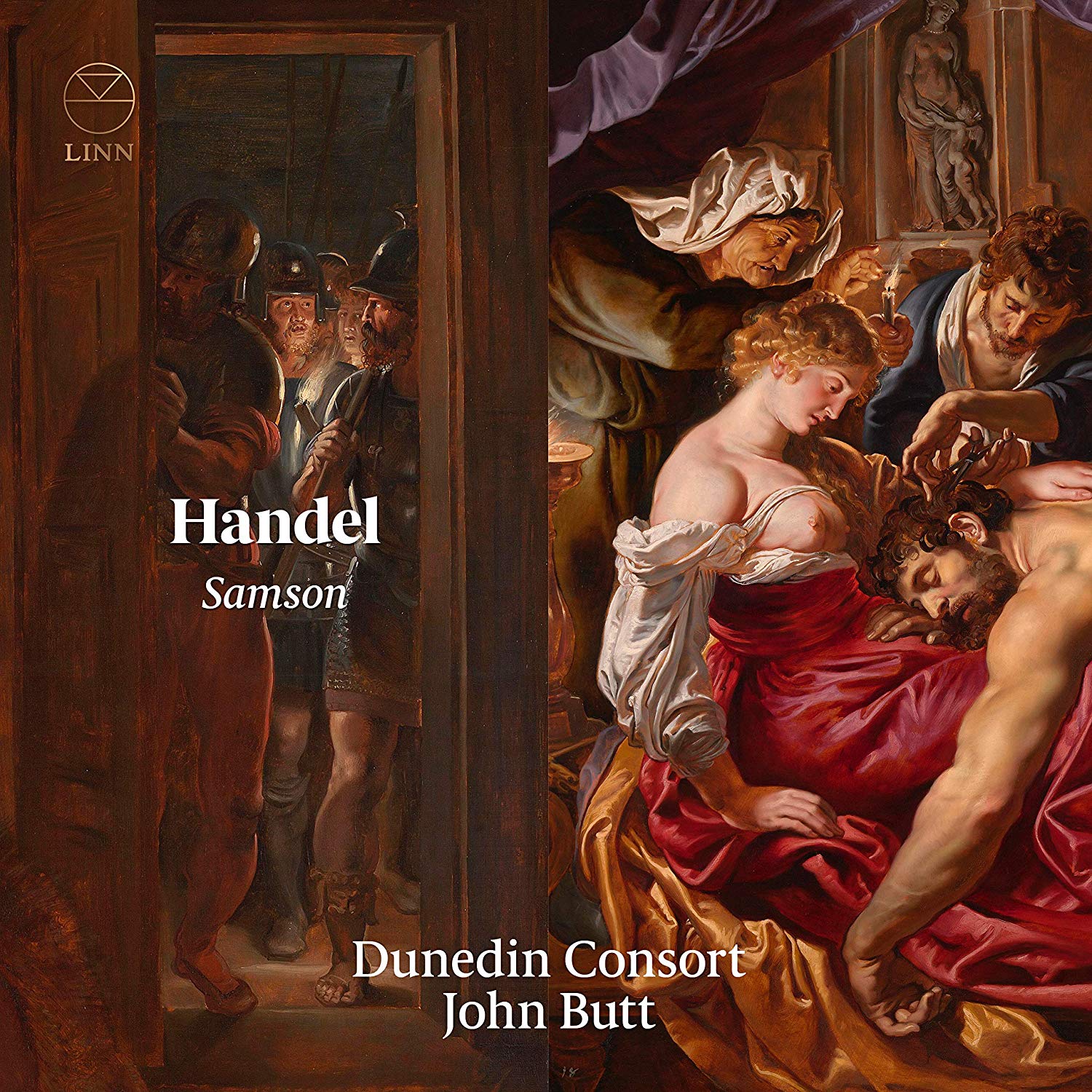
Quelques précédentes productions du Dunedin Consort
et de son chef John Butt
ont attiré _ et retenu _ mon attention
_ une Passion selon Saint-Matthieu de Bach, et un Requiem de Mozart, tout spécialement (chez Linn Records).
…
…
Et voici que vient de paraître un Samson de Haendel _ un coffret de 3 CDs Linn CKD 599.
…
Une œuvre qui connut,
après sa première à Londres le 18 février 1743 _ au Théâtre de Covent Garden _
un très notable durable succès :
…
« It was Handel’s most frequently performed dramatic oratorio during the rest of eighteenth century » _ rien moins ! _,
apprenons-nous à la page 16 du livret _ sous la plume de Ruth Smith _ de cette superbe production…
…
Deux raisons à cela :
d’une part la renommée persistante du poème sur lequel est bâti cet oratorio, Samson Agonistes (publié en 1671), de John Milton (1608 – 1674) ;
et d’autre part, la très grande qualité musicale de la partition de ce Samson de Haendel (1685 – 1759).
…
…
Pour conforter le plaisir pris à ces 3 heures 25 de musique,
…
voici deux articles confirmant ma propre appréciation de cette réalisation discographique
de très haut niveau ;
…
l’un emprunté à Stéphane Degott sur le site de Res Musica,
est un article intitulé Un des plus beaux oratorios de Haendel en CD :
…
et l’autre sur le site de MusicWeb International à propos de ce coffret Samson de Linn.
…
…
Les voici :
…
…
…
…
Le 27 décembre 2019 par Pierre Degott
Interprété par les forces écossaises de John Butt, cette nouvelle version pourrait bien se placer au sommet _ voilà ! _ de la discographie. Distribution impeccable, fluidité chorale et orchestrale, clarté de la diction _ tout particulièrement : c’est admirable de bout en bout ! _, tous les éléments sont réunis pour faire de ce CD un nouveau jalon _ oui _ dans la discographie haendélienne.
…
…
…
…
…
…
…
…
…
…
…
…
…
…
…
…
…
…
…
…
…
Inspiré du drame sacré de John Milton Samson Agonistes, Samson de Haendel est un ouvrage injustement négligé de nos jours, sans doute à côté du statisme imputable à sa source – un drame conçu pour la lecture _ voilà ! _ et non pour la scène – qui n’en fait pas le candidat idéal pour les tentatives actuelles de mise en scène _ ah ! la maladie de la mise en spectacle ! _ dont font l’objet les oratorios anglais de Haendel. La qualité de la musique en est pourtant exceptionnelle _ voilà ! _, ce qui est loin d’être le cas de tous les oratorios, et l’ouvrage ne manque pas d’occasions d’exhiber de belles prestations vocales. L’opposition entre les Israélites et les Philistins permet en effet de confronter deux langages musicaux, celui fondé sur le chœur, le récitatif et l’arioso, contrasté avec le style plus léger, plus dansant et plus vocal qui marque la partie philistine. Bien malin celui qui saura dire de quel côté penchait réellement Haendel, qui à l’époque de la composition de Samson venait de faire ses adieux définitifs à l’opéra italien _ et c’est à relever, bien sûr…
…
Un des grands atouts de cette version concerne la diction impeccable _vraiment ! à la française, dirais-je presque… _ des solistes, dont on entend distinctement chaque syllabe _ oui ; et plus encore les mots, les phrases, avec leurs intentions… Et ce qui en résultait, bien sûr, pour le public. Ce compliment est valable également pour le chœur, d’une grande limpidité _ oui. Aux voix du Dunedin Consort s’ajoutent d’ailleurs les sopranos garçons du Tiffin Boys’ Choir, autre institution britannique qui fait honneur à la nation. Dans le rôle du héros déchu et torturé, le ténor Joshua Ellicott délivre une prestation d’anthologie _ oui, vraiment ! Il est de bout en bout admirable ! _, qui ne serait pas sans rappeler le Jon Vickers d’antan si les moyens vocaux n’étaient si différents. Loin d’être intrinsèquement belle, la voix sait jouer de toutes les couleurs expressives _ voilà ! _ pour transcrire la gamme d’émotions _ oui _ associées à ce personnage tragique entre tous. Elle s’oppose à ce titre au timbre juvénile du jeune Hugo Hymas, très à l’aise dans les acrobaties et les vocalises des différents personnages dont il a la charge. Les deux basses font belle figure également, et l’on retrouve avec le plus grand plaisir Matthew Brook, émouvant Manoa dont le chanteur traduit à la perfection la bonté et la noblesse. Son air How willing my paternal love comptera parmi les sommets de cet enregistrement. Dans le rôle plus fanfaronnant du géant Harapha, le Russo-Américain Vitali Rozynko est lui aussi idéalement distribué. Chez les dames, notons l’apparition du bel alto cuivré de Jess Dandy, tout à fait dans la tradition de ces voix graves féminines anglaises. Une fois encore, les producteurs auront réuni les sœurs Bevan pour une réalisation haendélienne. Le timbre de l’aînée, Sophie, contient ce petit sifflement qui traduit idéalement la perfidie de Dalila. Un rien plus léger, celui de Mary sert au mieux les diverses interventions, plus virtuoses, de personnages féminins secondaires sur le plan dramatique mais essentiels pour les démonstrations de virtuosité vocale _ à l’italienne, là… _ encore attendus _ en effet _ du public du début des années 1740. On découvre avec le plus grand plaisir le soprano fruité et léger de la Galloise Fflur Wyn, qu’on espère entendre bientôt dans d’autres incursions. Tous les solistes confortent les chanteurs du Dunedin Consort, emmenés par leur chef John Butt avec élan, énergie et sincérité _ tout cela. Après Esther et l’Ode à Sainte Cécile, on attend avec impatience les prochaines réalisations discographiques du Dunedin Consort.
…
George Frederic Haendel (1685-1759) :
Samson HWV 57, oratorio ou drame sacré en trois actes sur un livret attribué de Newburgh Hamilton tiré du Samson Agonistes de John Milton. Avec : Joshua Ellicott, Samson ; Jess Dandy, Micah ; Matthew Brook, Manoa ; Vitali Rozynko, Harapha ; Sophie Bevan, Dalila ; Hugo Hymas, Un Israélite, un Philistin, le Messager ; Mary Bevan, Une jeune fille, une Israélite, une Philistine ; Fflur Wyn, une jeune fille, une Philistine. Tiffin Boys’ Choir (chef de chœur : James Day).
Dunedin Consort, direction : John Butt. 3 CD.
Linn Records CKD 599.
Enregistré du 29 mai au 5 juin 2018.
Notice de présentation en anglais.
Durée : 75:29, 76:11 et 52:44.
LINN
…
…
 |
George Frideric HANDEL (1685-1759)
Samson (1743 version)
Samson – Joshua Ellicott (tenor)
Micah – Jess Dandy (alto)
Manoa – Matthew Brook (bass)
Harapha – Vitali Rozynko (bass)
Dalila – Sophie Bevan (soprano)
Israelite/Philistine/Messeger – Hugo Hymas (tenor)
Virgin/Israelite Woman/Philistine Woman – Mary Bevan (soprano)
Virgin/Philistine Woman – Fflur Wyn (soprano)
Tiffin Boys’ Choir
Dunedin Consort/John Butt (harpsichord)
rec. 2018, St Jude-on-the-Hill, Hampstead Garden Suburb, London
LINN CKD599 [3 CDs: 204:14]
…
…
Handel wrote Samson around the same time as Messiah _ c’est à relever ! _, and in his day it was probably his most popular oratorio _ voilà. I suspect the reason why we don’t hear it so much now is its sheer scale and length. What better method to experience it, then, than through this wonderful new Dunedin Consort recording, which brings it so life _ oui _ so vividly that you’ll want to return to it again and again?
…
In fact, a recording suits Samson for other reasons too. The text is an adaptation of Milton’s verse drama Samson Agonistes, which Milton designed for private reading, not for performance _ oui. The drama is essentially static and reflective _ voilà _, encouraging the reader to conceive events in his mind’s eye, so the action mostly takes place off stage _ voilà _ and is commented on by the characters. Act 1 opens, for example, with Samson already blinded and imprisoned, and the climactic destruction of the temple takes place offstage to the accompaniment of some brilliantly busy string writing. The whole “action” consists of monologues and dialogues between characters who don’t do much more than discuss _ voilà _ their states of mind.
…
Handel, therefore, creates an “opera of the mind.” An oratorio is that already, of course, but a recording even more so, and this one gives so much to not just enjoy but revel in. For one thing, the sound is top notch. Linn’s engineers have done a superb job of capturing everything with a wonderful sense of clarity _ oui _ and space, and their choice of venue is perfect for balancing the intimacy of the solos with the brilliance of the choruses without ever losing the colouristic detail _ oui _ of the orchestral playing.
…
Behind it all sits director John Butt, who has thought the work through from top to bottom, as he explains in a scholarly but accessible booklet note. He has given great consideration to which version to perform and how ; and while I’m open to correction on this, it would seem that this version is the most encyclopaedic _ oui _ to have been put on disc so far. Unsurprisingly, Butt has given huge thought to the size of the forces used, and his conclusions are most interesting when it comes to the choruses. He finds evidence for two different sorts of chorus to be used : the smaller involves basically the soloists plus an extra alto, while the larger involves more forces and the addition of several boys. Typically, Butt has recorded both, and you can download both from the Linn website _ je ne sais pas trop comment… The CD features only the larger chorus but, in a very generous move, if you buy the CD then you get a voucher _ ??? je n’en ai pas trouvé trace en mon exemplaire.. _ which will allow you to download for free the version with the smaller chorus.
…
Whichever you choose, you’ll find a Dunedin Chorus on top form. In his most bravura style _ et les chœurs sont fondamentaux dans les oratorios de Haendel _, Handel hits his audience with a Philistine chorus in praise of Dagon at the very beginning of the piece, and it sounds fantastic here, the chorus relishing every syllable and bouncing brilliantly off the trumpets and drums that blaze out of the orchestra. They are brilliantly subtle elsewhere, too, effectively bringing out the counterpoint of choruses like O first created beam or, especially, Then shall they know. The combative chorus (Israelites vs Philistines) that ends Act 2 is a thriller, and the blaze of glory that brings down the curtain after Let the Bright Seraphim is a fantastic way to end.
…
Having listened to both versions, I really appreciate the benefits of the smaller chorus : they sound great, and there’s something lovely about hearing these expert singers more “up close” in harmony. For sheer dramatic power, so important in this work, my own taste tended to prefer the full chorus over the smaller one, but it’s lovely that, buying the CD, you can have both, thus avoiding the agony of choice.
…
The orchestral picture is equally superb _ oui. Violins are light and bouncy, by turns delicate and fresh. Winds chatter convincingly and, particularly in the opening Sinfonia, horns add a welcome touch of grandeur. They aren’t used often but, when they are, the trumpets and drums make a fantastic impact, nowhere more so than in the electrically exciting final bars. Butt himself on the harpsichord underpins everything with great authority but also a twinkle in his eye, never forgetting that this is meant to be a drama, and in his hands it is never less than compelling.
…
It’s hard to imagine a better team of soloists, either, not least because most (if not all) of them are regular Dunedin collaborators. In the title role, Joshua Ellicott’s tenor voice is full of dramatic impulse _ oui _, inhabiting the damaged hero’s character brilliantly _ absolument ! Son incarnation de Samson est d’une intense puissance. There is, for example, a strain of pain running through Torments, alas which works very well, and even in the recitatives you get the sense of a wounded lion looking back over his achievements from a place of agony, nowhere more so than in the interactions with Dalila. Total eclipse is deeply poignant _ quelle merveille d’interprétation ! quel chef d’œuvre ! _ , the high climax on “stars” sounding like a stab wound, but Why does the God of Israel sleep buzzes with a palpable uplift in energy. Just as the sun is sung with beautiful tenderness, and what a brilliantly original move of Handel’s for the hero to exit on such a delicately understated aria. Hugo Hymas’ lighter tenor stands in effective contrast to Ellicott’s, and he uses the flexible agility of his tenor to magnificent effect, leaping all over the coloratura in Loud as the thunder’s awful voice and enlivening the runs of God our our fathers with great beauty. He’s equally convincing in the swagger of To song and dance we give the day, and he delivers the news of the temple’s destruction with keen dramatic sense.
…
Sophie Bevan brings seductive allure to the role of Dalila, with a particularly sultry colour to the middle of the voice, making her protestations of contrition sound utterly unconvincing ! Her sister, Mary Bevan, uses her voice to fantastic effect, sounding alluring and sensual in Ye Men of Gaza, and using the sultry bottom of her voice every bit as effectively as the gleaming top in seductive moments like With plaintive notes or, sensationally, Let the bright seraphim. Fflur Wyn is lighter and brilliantly agile. She has a real sit-up-and-notice quality to her voice that really helps in Then free from sorrow and, particularly, the recriminations of It is not virtue. Jess Dandy’s authoritative mezzo brings great substance to the role of Micah, an Israelite woman who consoles Samson, nowhere more effectively than in her brief but fantastically long-breathed arioso Then long eternity. There is great beauty in her prayer Return, O God of Hosts ! and her lament for the dead Samson is beautifully sustained.
…
Matthew Brook radiates authority as Manoa, Samson’s father, singing with both poignancy and great clarity in the long runs of Thy glorious deeds, and he comes into his own in the oratorio’s final section with his music of meditation as he reflects on his son’s role in bringing down the Philistines. With a completely different bass voice, I really liked the touch of try-your-chance insolence to the Harapha of Vitali Rozynko, reinforcing the drama and underlining the sense of this work as an opera of the mind that works through sound alone.
…
In short, this is superb _ oui ! _, the best Handel oratorio I’ve heard in years _ rien moins ! voilà ! Its individual components are all first rate, but the cumulative whole is even more effective than the sum of its parts when you consider the packaging, the scholarship and the overall impact. The excellent historical notes from Ruth Smith only seal the deal.
…
Simon Thompson
…
…
Une réalisation haendelienne on ne peut plus marquante, par conséquent,
pour cet admirable chef d’œuvre qu’est Samson.
…
Avec une mention toute spéciale, aussi,
pour le magnifique ténor qu’est Joshua Ellicott (Samson),
et, notamment, son interprétation du sublime air Total eclipse ! (Acte 1, scène 2 ; plage 16 du CD 1)…
…
…
Ce dimanche 29 décembre 2019, Titus Curiosus – Francis Lippa